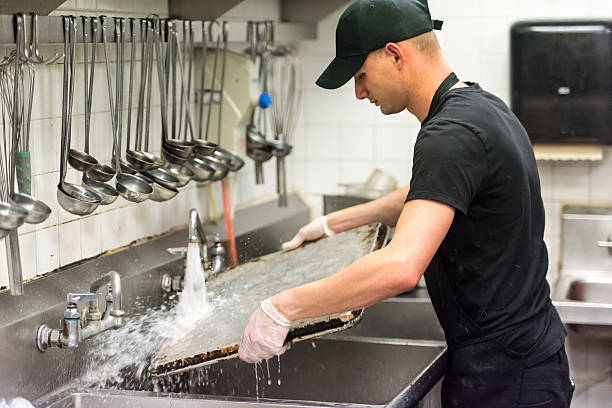

Looking for restaurant cleaning services near me jobs that are stable, safe, and growth-friendly—here’s how to target the roles, skills, and employers that say “yes.”
1) THE 2025 U.S. MARKET SNAPSHOT: WHY CLEANING ROLES ARE STILL IN DEMAND
The restaurant workforce has edged above pre-2020 levels, and operators expect steady guest traffic and ongoing hiring throughout 2025. Building-and-grounds and janitorial roles—covering back-of-house (BOH) and front-of-house (FOH) sanitation—are projected to grow at a pace comparable to the broader labor market, with hundreds of thousands of openings annually due to turnover and expansion. Operators also report continuing investment in safety, sanitation, and operational consistency. Meanwhile, selective automation is entering kitchens and prep areas, but adoption remains limited; in most venues, people remain central to cleaning and sanitation operations.
2) WHERE THE JOBS ARE: ROLE TYPES & WORK ARRANGEMENTS
When you search “restaurant cleaning services near me,” you’ll typically find three pathways:
- In-house restaurant roles (dishroom, night porter, BOH/FOH attendant, utility, sanitation tech)
- Commercial contractors (assigned to multiple restaurants; sometimes specialized in commercial kitchen cleaning)
- Property or facility teams (multi-tenant food halls, entertainment venues, campuses)
Related search terms to use: restaurant cleaning jobs near me, commercial kitchen sanitation, BOH cleaning, FOH sanitation, kitchen porter, night cleaning crew, deep-clean team, hood and duct cleaning roles, dishroom sanitation jobs.
3) COMPARISON TABLE — WHICH PATH FITS YOUR GOALS?
| Path | Hiring Speed | Schedule Control | Training Provided | Stability | Site Variety | Advancement Potential |
|---|---|---|---|---|---|---|
| In-house restaurant cleaner | Medium | Medium | High on food-safety routines | Medium–High | Low (one brand/site) | Cross-train to prep/utility |
| Commercial cleaning contractor | Fast | Medium–High | Structured by contractor | High if multi-client | High (many sites) | Lead/crew supervisor |
| Facility/property team | Medium | Medium | Consistent SOPs | High (institutional) | Medium | Facilities & compliance tracks |
4) QUALIFICATIONS THAT GET QUICK “CALL-BACKS”
- Food-safety literacy: Know the basics of cleaning vs. sanitizing vs. disinfecting, and the order of operations for food-contact surfaces (wash → rinse → sanitize → air-dry).
- Chemical handling & PPE: Read labels, follow dilution and contact-time instructions, and use gloves, eye protection, and aprons when required.
- Equipment basics: Familiarity with dishmachines, three-compartment sinks, floor scrubbers, foamers/sprayers, and hood-filter protocols.
- OSHA awareness: Know how to work safely around wet floors, hot equipment, sharps, and ventilation areas; follow sanitation and potable-water rules.
- Reliability & shift flexibility: Evening/overnight availability often wins BOH sanitation roles.
- Documentation: Valid work authorization; clean, concise resume highlighting sanitation achievements.
5) HOW TO SEARCH SMART: FROM “restaurant cleaning services near me” TO INTERVIEWS
- Geo-targeted queries: Combine the core term with your ZIP code or neighborhood (e.g., “restaurant cleaning services near me 30309,” “BOH sanitation night shift Oakland”).
- Add long-tails: “commercial kitchen cleaning positions,” “dishroom sanitation jobs overnight,” “food hall cleaning crew jobs.”
- Filters that matter: Shift (evening/overnight), job type (part-time/full-time), and “sanitation”/“utility” keywords.
- Portfolio of readiness: Keep a one-page resume and a short “sanitation checklist” you’ve used (e.g., opening/closing routines, hood/duct weekly steps) to show operational thinking.
- Leverage multi-site contractors: They can place you faster across several client restaurants if one location slows down.
6) WHAT HIRING MANAGERS LOOK FOR (AND HOW TO SIGNAL IT)
- Consistency and tempo: Mention metrics like “closed dishroom in 45 minutes with full delime/sanitize cycle” or “reduced slip incidents by maintaining dry-mop pass after deck-scrub.”
- Food-contact discipline: Describe how you avoid cross-contamination (color-coded tools, separate buckets for floors vs. prep tables).
- Regulatory alignment: Reference knowledge of the Food Code standards for cleaning and sanitizing food-contact surfaces and warewashing.
- Team communication: BOH sanitation is a hand-off role; emphasize checklists and verbal shift pass-offs.
7) THE TECH FACTOR: AUTOMATION WITHOUT REPLACEMENT
You’ll see headlines about robotics or automated lines assisting with prep. In practice, adoption remains modest, and most U.S. operators still rely on people for sanitation and end-of-day resets. For candidates, this means human-led cleaning remains a durable entry point—and tech awareness is a plus (e.g., using sensor-based dishmachines, reading digital chemical-feed panels).
8) PRACTICAL SKILLS CHECKLIST FOR DAY-ONE IMPACT
- Know the zones: FOH touch points (tables, rails, menus), BOH hot zones (cookline, fryers, hoods, drains).
- Sequence matters: Dry-scrape → wash → rinse → sanitize → air-dry; clean high to low; clean food-contact before floors.
- Contact times & test strips: Verify sanitizer strength; respect dwell time.
- Slip-trip-fall prevention: Cones/signage, mat maintenance, and dry-mop finishes.
- Waste & grease protocols: Separate recycling/landfill, handle grease traps and hood filters on schedule.
- Ventilation & ducts: Understand when to escalate to specialized deep-clean crews for hoods/ducts.
9) INTERVIEW PREP: QUESTIONS THAT MAKE YOU STAND OUT
- “How do you verify sanitizer concentration for food-contact surfaces?”
- “What’s your closing checklist for dishroom and cookline?”
- “How do you train new hires on chemical labels and PPE?”
- “What KPIs matter for your sanitation team (incident rates, re-clean calls, inspection scores)?”
- “Do you cross-train cleaners into prep or utility roles after 90 days?”
10) SAMPLE ONE-WEEK RAMP PLAN (TO SHARE IN INTERVIEWS)
- Day 1: Shadow BOH cleaner; review PPE, chemical SDS, and Food-Code-aligned routines.
- Day 2–3: Own dishroom close; perform delime cycle; verify sanitizer with test strips; document times.
- Day 4: Assist hood-filter pull/soak; degrease floor; complete drain maintenance log.
- Day 5: Lead FOH close; touch-point checklist; slip-prevention dry-mop; sign off with manager.
- Day 6–7: Rotate to line support during peak; run expedited clean-as-you-go routine; propose one improvement.
11) RED FLAGS & HOW TO PROTECT YOURSELF
- No PPE or unclear chemical labeling → Ask for training and safety data sheets.
- No potable-water access or poor hand-wash support → Escalate; these are required workplace sanitation fundamentals.
- Pressure to skip contact times → Reiterate standards; consistent sanitation protects guests and teams.
- Chronic wet floors without signage → Recommend cones, matting, and end-of-shift dry-mops.
12) CALL TO ACTION
Start with your local search—type restaurant cleaning services near me and the long-tail variants above. Build a two-page “sanitation portfolio” (resume + checklist), highlight your Food-Code and OSHA safety awareness, and target roles with clear training and advancement. Apply to two in-house roles, two contractors, and one facility team this week—then prepare the interview answers and the one-week ramp plan to land offers faster.