

A single colorized black-and-white photograph can fundamentally transform how we connect with history—turning distant, monochromatic moments into vivid scenes that feel immediate and emotionally resonant. Yet for decades, manual colorization remained a painstaking craft requiring hours of meticulous hand-tinting per image, with results that varied dramatically depending on the artist’s skill, historical knowledge, and subjective interpretation. Today, artificial intelligence has not only automated this process but has pushed it into entirely new territory: real-time photo colorization on smartphones, consistent palette harmonization across entire archival collections, and the tantalizing—yet technically demanding—frontier of temporally coherent video colorization. This guide explores the four technical pillars driving modern photo colorization: exemplar-based color propagation, sequence-aware transformer models, real-time lightweight architectures, and rigorous quality benchmarking—and reveals how each pillar extends naturally to the challenges of video, where the flicker nobody admits remains the field’s most persistent obstacle.

The journey from grayscale to living color has been one of computer vision’s most visually striking success stories. Early approaches to automatic photo colorization relied on simplistic heuristics—the sky must be blue, grass must be green—and produced results that looked more like crude paint-by-numbers than believable photographs. The deep learning revolution changed everything. Convolutional neural networks (CNNs) trained on millions of color images learned to predict plausible chrominance values from luminance inputs, and the results were often indistinguishable from naturally captured color photographs. Researchers at the University of California, Berkeley demonstrated in their seminal 2016 paper that a CNN could automatically colorize grayscale images with remarkable fidelity, sparking a wave of academic and commercial interest that continues to accelerate nearly a decade later. Today, tools like DeOldify, MyHeritage’s photo colorization feature, Adobe Photoshop’s Neural Filters, and Palette.fm have brought this technology to millions of users worldwide, making AI photo colorization one of the most democratized applications of deep learning.
However, the transition from compelling demos to production-grade reliability has exposed fundamental challenges that the research community is still working to solve. Colorization is fundamentally an ill-posed problem: a single grayscale value can correspond to dozens of plausible colors. A gray pixel could be skin, stone, sky, or fabric. Resolving this ambiguity requires semantic understanding, contextual reasoning, and—increasingly—the ability to maintain consistency across multiple related images or sequential video frames. These challenges have given rise to four interconnected lines of research that collectively define the state of the art in deep learning colorization.
Exemplar-Based Colorization: Propagating Color from Reference Images
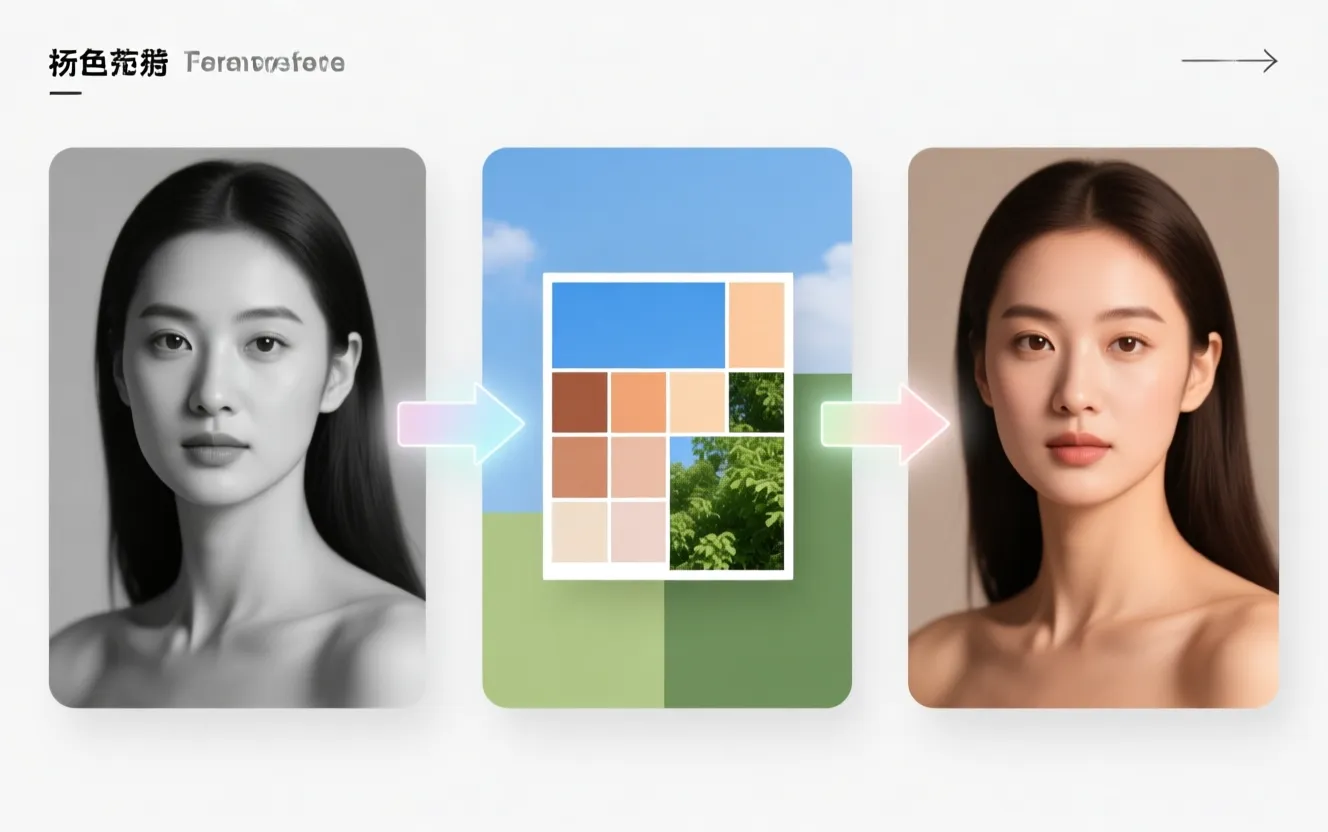
One of the most intuitive approaches to solving the color ambiguity problem is to provide the model with a reference—an exemplar image whose color palette can guide the colorization of a target grayscale photo. This technique, known as exemplar-based colorization, mirrors how human colorization artists work: they study reference photographs from the same era, location, or subject matter to make historically informed color choices. Deep exemplar-based models automate this process by learning to establish dense semantic correspondences between the reference and target images, then transferring chrominance information along those correspondences while preserving the target’s luminance structure.
The core technical challenge lies in the correspondence matching. Early exemplar-based methods used hand-crafted features like SIFT or SURF descriptors to find matching regions, but these often failed when the reference and target images differed significantly in composition, pose, or viewpoint. The breakthrough came with deep semantic features extracted from pre-trained networks like VGG-19, which capture high-level semantic similarity even across substantial visual differences. A model can recognize that a region in the reference image represents “sky” and transfer the appropriate blue tones to the corresponding sky region in the target—even if the cloud patterns, horizon placement, and image dimensions differ completely. The same principle extends naturally to video colorization, where the “reference” becomes the preceding frame and color must propagate forward through time rather than across a single image pair.
Optical flow—the pattern of apparent motion between consecutive video frames—becomes the critical enabling technology when extending photo colorization to video. By computing dense motion vectors that track how each pixel moves from one frame to the next, optical flow algorithms allow color information assigned to an object in frame N to be warped and carried forward to frame N+1, maintaining consistency even as the object translates, rotates, or deforms. However, optical flow estimation is itself imperfect, particularly near occlusion boundaries, in regions of rapid motion, or under changing lighting conditions. When flow estimation fails, color can “slip” off objects, creating the temporal flicker that remains the most visible artifact in AI video colorization. State-of-the-art approaches address this by combining bidirectional flow consistency checks, occlusion-aware warping, and learned temporal filters that suppress frame-to-frame chrominance variation. Companies like Pixop and neural networks developed at institutions including the Tokyo Institute of Technology have demonstrated impressive results in archival footage restoration, though the flicker problem has not yet been fully solved—hence the title of this article.
Sequence-Aware Transformers: Long-Range Consistency for Archival Collections
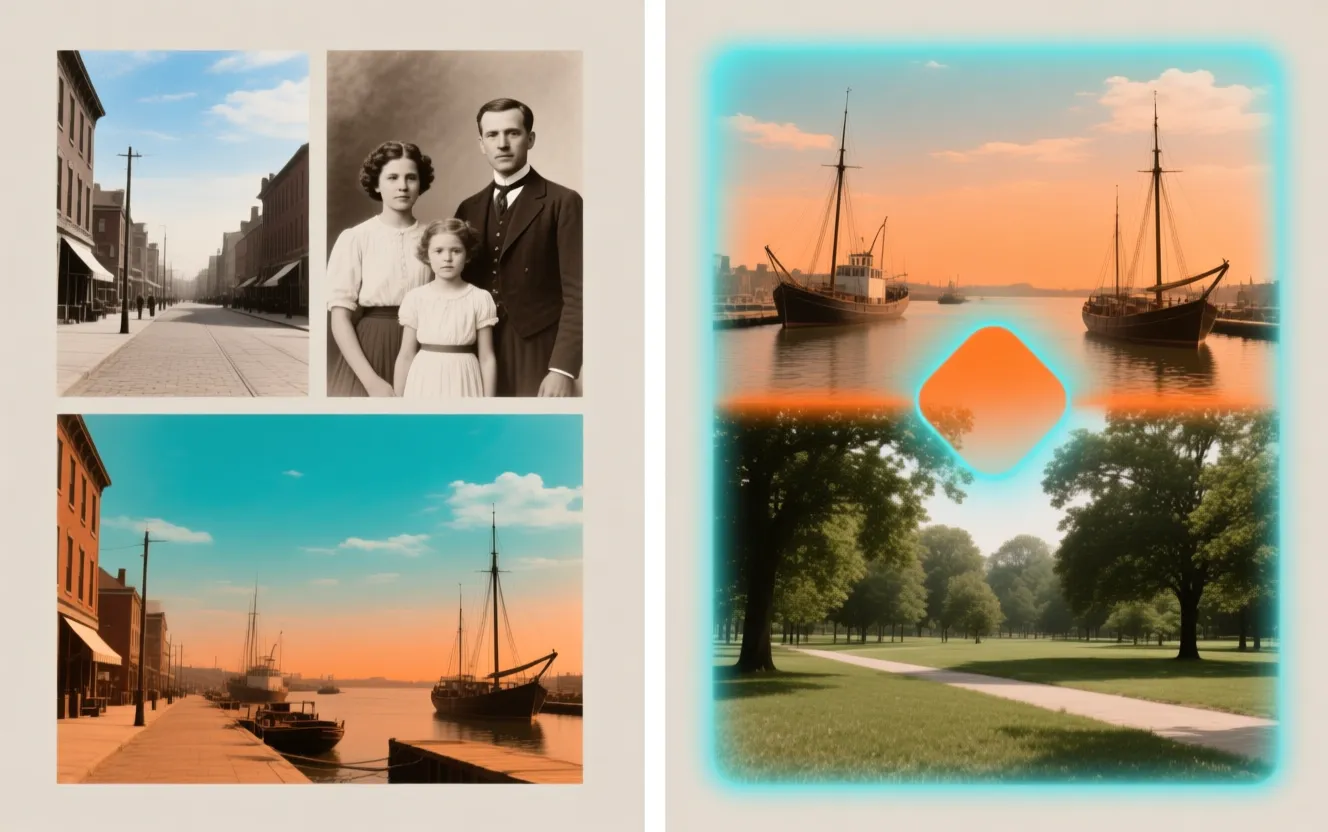
While exemplar-based methods excel at transferring palettes between pairs of images, they struggle with a different kind of consistency challenge: harmonizing color across an entire collection. Consider a set of 200 photographs from a single historical event—a World War II battalion, a 1960s civil rights march, or a family album spanning decades. Colorizing each photo independently, even with the best single-image model, often produces subtly inconsistent results: the same uniform appears olive green in one image and khaki in another, skin tones shift unpredictably, and the overall visual coherence that makes a collection feel unified is lost.
Transformer architectures, originally developed for natural language processing and now dominant across computer vision, offer a powerful solution to this long-range consistency problem. Unlike convolutional networks, which process images through local receptive fields and build up global context hierarchically, transformers use self-attention mechanisms that allow every pixel to directly attend to every other pixel in the image. This global receptive field means that a transformer-based colorization model can make color decisions for a patch of fabric while simultaneously considering the color of a semantically related patch on the opposite side of the image—or, in the archival use case, in an entirely different photograph from the same collection.
The recently proposed Colorization Transformer (ColTran) and its successors demonstrate how attention-based architectures can maintain palette consistency across images that share contextual or temporal relationships. By feeding the model multiple related images simultaneously and allowing cross-image attention, these systems learn to enforce a unified color palette without requiring explicit pairwise alignment. This capability has profound implications for photo restoration AI applied to museum archives, where curators need entire collections colorized with historically plausible and internally consistent palettes. When extended to video, the same sequence-aware attention mechanisms can model dependencies across dozens or hundreds of frames rather than just adjacent pairs, enabling the long-range temporal consistency needed to eliminate the slow color drift that plagues frame-by-frame colorization of extended footage. Research teams at Google Research and the Max Planck Institute for Intelligent Systems have published compelling results showing that transformer-based video colorization can maintain stable skin tones and consistent environmental colors over sequences lasting several minutes—a dramatic improvement over frame-independent methods.
Real-Time Colorization: Lightweight Architectures and GPU Acceleration
For all their quality improvements, the models described above share a common limitation: they are computationally expensive. A high-quality transformer-based colorization of a single high-resolution photo can require billions of floating-point operations, taking seconds or even minutes on consumer hardware. For applications ranging from interactive photo editing to live video streaming, this latency is unacceptable. The demand for real-time colorization has driven a parallel research track focused on efficiency: how can we deliver near-instantaneous results without sacrificing the quality gains achieved by larger models?
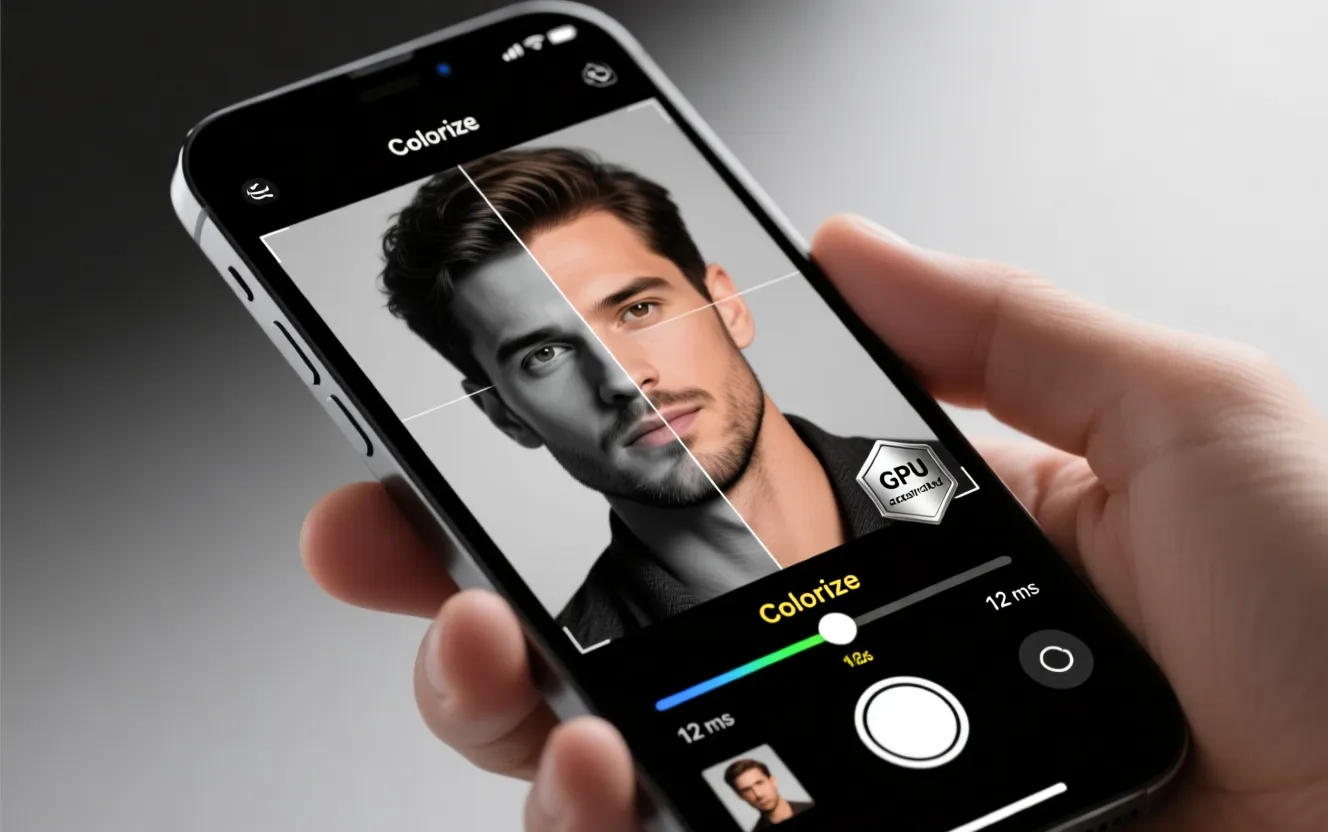
The answer has come through a combination of architectural innovations and hardware-aware optimization. Lightweight CNN architectures employing depthwise separable convolutions—pioneered by MobileNet and adopted across mobile vision applications—reduce parameter counts and computational requirements by factors of 10x to 50x compared to their full-size counterparts, while retaining surprisingly competitive colorization quality. Knowledge distillation takes this further: a large, high-quality “teacher” model generates training targets for a compact “student” model, allowing the student to learn richer color distributions than it could from ground-truth data alone. The resulting models are small enough to run on smartphone processors and fast enough to deliver results in milliseconds, enabling features like the live colorization previews now found in apps such as Colorize by Photomyne and Remini.
GPU acceleration has been equally transformative for throughput-oriented applications. A modern NVIDIA GPU with dedicated tensor cores can process an entire batch of photos in the time it takes a CPU to handle a single image, making it practical to colorize entire photo libraries—tens of thousands of images—in minutes rather than days. This capability has been crucial for archival institutions like the Library of Congress and the Smithsonian, which hold millions of historical photographs and have begun exploring AI-assisted digitization pipelines. For video, GPU-accelerated inference is not just convenient but essential: colorizing a single hour of 24fps footage at 1080p resolution requires processing over 86,000 frames, and doing so in anything approaching real time demands the parallel processing capabilities that only GPUs can provide. Streaming deployment architectures, often built on frameworks like NVIDIA’s DeepStream or custom ONNX Runtime pipelines, now enable live video colorization at frame rates approaching 30fps with acceptable quality, though the most demanding applications—broadcast-quality restoration, for example—still require offline processing with more powerful models.
Benchmarking Colorization Quality: Metrics, Flicker, and Evaluation Standards
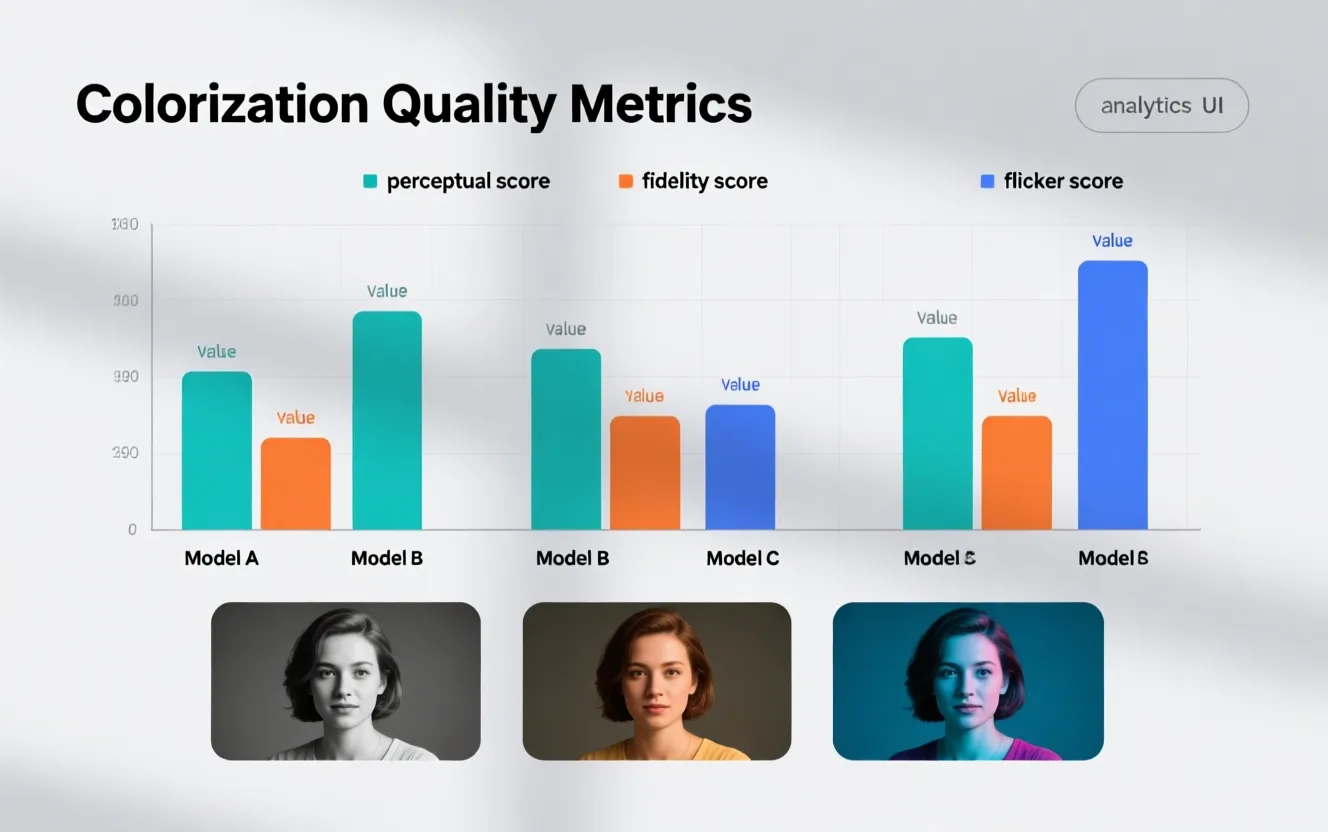
How do we know whether a colorization model is actually good? The question is deceptively simple and has spawned an entire subfield of evaluation methodology. Traditional image quality metrics like Peak Signal-to-Noise Ratio (PSNR) and Structural Similarity Index Measure (SSIM) measure how closely a colorized output matches a ground-truth color image at the pixel level. These metrics are straightforward to compute and widely used in the literature, but they fundamentally misalign with how humans perceive colorization quality. A model that produces a perfectly plausible but slightly “wrong” color—a blue sweater colorized as green, for instance—may score poorly on PSNR despite producing a result that looks natural and convincing to human viewers.
This recognition has driven the adoption of perceptual metrics that better correlate with human judgment. Learned Perceptual Image Patch Similarity (LPIPS), which uses deep network features to compare images in a semantically meaningful space, has become a standard complement to pixel-based metrics. Fréchet Inception Distance (FID), borrowed from the generative adversarial network (GAN) literature, measures how closely the distribution of colorized images matches the distribution of real color photographs—capturing the overall “naturalness” of results rather than per-pixel accuracy. Structured user studies remain the gold standard: platforms like Amazon Mechanical Turk are used to present human raters with colorized images alongside references, asking them to judge which results look more natural, more plausible, or more aesthetically pleasing. These studies consistently show that modern AI colorization models produce results that are indistinguishable from real color photographs in a significant majority of cases.
The evaluation challenge becomes substantially more complex for video. In addition to per-frame quality, video colorization must be assessed for temporal stability: do colors remain consistent from frame to frame, or do they flicker, drift, and oscillate in ways that distract viewers? Temporal flicker metrics have been proposed to quantify this, typically measuring the variance of chrominance values in corresponding regions across consecutive frames after compensating for motion. The Warp-Error metric, for instance, uses optical flow to align frames and then measures the residual chrominance difference, with lower values indicating better temporal consistency. Public benchmarks incorporating these metrics—such as the DAVIS dataset adapted for video colorization evaluation—are finally enabling fair, reproducible comparisons across different approaches. The development of standardized evaluation protocols, led by research groups at ETH Zurich, Tsinghua University, and Adobe Research, represents a critical step toward maturing the field from a collection of compelling demonstrations into an engineering discipline with clear quality standards.
Conclusion: The Unified Future of Photo and Video Colorization
The four technical pillars explored in this guide—exemplar-based color propagation, sequence-aware transformer architectures, real-time lightweight models, and rigorous quality benchmarking—together define the modern photo colorization technology stack. Each addresses a distinct aspect of the problem: where color information comes from, how it remains consistent across space and time, how it can be delivered at interactive speeds, and how we measure whether the results are actually good. None of these pillars stands alone; the most impressive systems, from DeOldify to Adobe’s Neural Filters to commercial archival restoration pipelines, integrate elements from all four.
The significance of accessible, high-quality colorization extends far beyond technical novelty. For museums and cultural institutions, it offers a way to make historical imagery feel immediate and emotionally accessible to contemporary audiences, preserving cultural memory in a form that resonates across generations. For families, it transforms faded black-and-white heirlooms into vivid windows into the past—a grandmother’s wedding, a father’s childhood, a great-grandfather’s immigration portrait suddenly rendered in the colors of lived experience. For filmmakers and archivists, it opens the possibility of breathing new life into vast repositories of monochromatic footage, from newsreels to home movies to early cinema.
Looking forward, the frontier is clear: unified models that seamlessly handle both photos and video, with adaptive quality metrics that account for both spatial and temporal fidelity. The integration of generative AI—particularly diffusion models that have recently transformed image synthesis—promises to further improve the richness and plausibility of colorized outputs. And as these models become ever more efficient, the dream of fully automatic, artifact-free, real-time colorization across all media formats is rapidly approaching reality. The flicker nobody admits may finally be extinguished, and when it is, our connection to the visual past will be richer than ever before.